Choosing the right feeding schedule can feel surprisingly complicated. A cat that wakes you at 5 a.m. may need smaller meals, while a large dog may do better with two measured portions. This is why many owners ask, “how often should a pet feeder dispense food?”
Veterinary nutritionist Dr. Lisa M. Freeman emphasizes, “Portion control is one of the most important parts of managing a pet’s weight.” Her advice matters because feeding frequency and food quantity are connected. A feeder dispensing tiny portions several times daily may support some cats, especially those that beg between meals. However, it may not suit a pet that eats too quickly, guards food, or needs medication with meals.
There is no universal schedule. Age, breed, weight, activity, health, and the food itself all influence the answer. Puppies and kittens often need more frequent meals. Healthy adult pets commonly follow one or two daily feedings, but individual needs differ. Start with your veterinarian’s portion guidance, then observe your pet’s energy, stool, weight, and hunger signals.
Watch closely.
A feeder can measure food accurately, but it cannot notice subtle changes in behavior. I once assumed a regular schedule would solve every feeding problem; it did not. Some pets need slower dispensing, while others need human supervision. The seven tips below explain how to adjust timing safely, avoid overfeeding, test the machine, and create a routine your pet can actually tolerate.
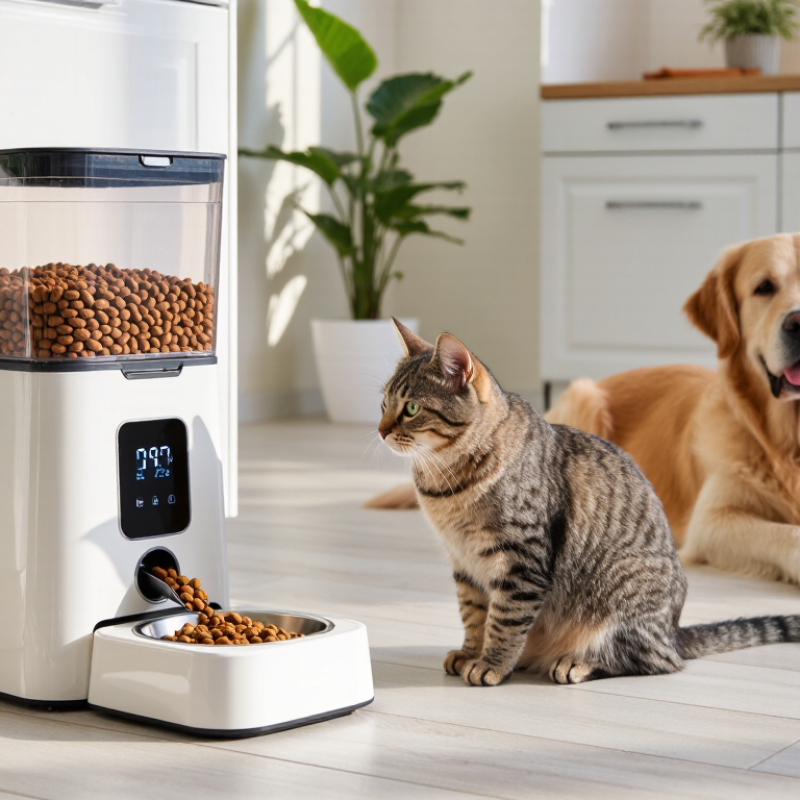
Feeding frequency should match the animal, not the machine. Most adult dogs do well with two measured meals daily, spaced about eight to twelve hours apart. Many adult cats prefer three or four smaller portions because their stomachs are small. Puppies and kittens need more frequent meals, often three to four times daily, depending on age and veterinary guidance.
Rabbits need constant access to fresh hay, while their pellets should remain carefully portioned. Birds and other small pets may require species-specific schedules. Check the feeder’s portion size with a kitchen scale, because “one serving” can vary widely.
A heavy meal at 7 a.m. may create problems by evening. Keep fresh water available.
Age and health can change everything. Senior pets may need smaller, easier-to-digest meals. Pets with diabetes, kidney disease, obesity, or digestive disorders may need timed feeding and prescription diets. A veterinarian should set those schedules.
I once trusted an automatic feeder without checking its output, and the portions were inconsistent. That mistake was easy to miss.
Monitor body weight, appetite, stools, and leftover food each week. Adjust slowly, not daily. Wet food also requires extra care because it can spoil when left at room temperature. A feeder is useful, but it cannot notice pain, nausea, or unusual hunger.
Puppies and kittens usually need smaller, frequent meals. Veterinary guidance commonly supports three to four meals daily during early growth. Puppies aged six to twelve weeks may need four meals. From three to six months, three meals often work well. Kittens under six months can also benefit from three or four measured servings. The Merck Veterinary Manual recommends age-appropriate portions and regular monitoring, not unlimited access to food.
Set the feeder to divide the veterinarian-approved daily calories evenly. For example, a puppy eating 240 calories daily could receive four 60-calorie meals. Space them across waking hours, such as 7 a.m., noon, 5 p.m., and 10 p.m. Kittens may prefer smaller portions because their stomachs are still developing. Fresh water should remain available. Wet food needs extra care because it should not sit out for long periods.
Portion control matters. The Association for Pet Obesity Prevention reported that about 59% of cats and 55% of dogs were overweight or obese in its 2022 survey. A feeder can prevent skipped meals, but it can also overfeed through careless settings. Check body shape, stool quality, energy, and weekly weight changes. The schedule is not magic. I would adjust it with veterinary advice rather than trust a preset program blindly. Recheck portions as the pet grows.
For most healthy adult dogs and cats, an automatic feeder should dispense two measured portions daily. This schedule mirrors a practical morning and evening routine. It can reduce frantic eating and make intake easier to monitor. I have found that consistent timing matters more than a fancy program. Small portions help, too. A pet may still beg.
Measure the full daily allowance with a kitchen scale or marked cup. Divide it into two equal servings unless a veterinarian recommends another plan. Set feeding times around your household, such as 7 a.m. and 6 p.m. Keep the gap reasonably steady. Dogs often tolerate this rhythm well, while cats may prefer smaller meals. Some cats do better with three or four servings from the same daily amount. More meals, not more food.
Watch the bowl, body shape, stool, and energy for two weeks after changing settings. Record leftovers and adjust carefully, rather than guessing. A feeder can misread irregular kibble sizes, so check its actual output several times. Puppies, kittens, pregnant pets, seniors, and animals with medical conditions may need different schedules. Ask a qualified veterinarian before changing their diet. I once assumed a “full” portion looked right, but the scale showed an extra 20 percent. That mistake was easy to make. Recheck the settings after cleaning or moving the feeder, because a small error can become a daily habit.
How Often Should a Pet Feeder Dispense Food?
Veterinary RER estimates a pet’s resting energy requirement with this formula: 70 × kg^0.75. For a 10-kilogram dog, the result is about 394 calories daily. This number supports planning, but it is not a complete feeding prescription. Age, neutering status, activity, body condition, and medical problems can change the final requirement. A growing puppy may need much more, while an older, inactive pet may need less.
Measure the food’s calories per gram, then divide the daily calorie target into controlled portions. Many adult pets do well with two or three meals. Smaller portions may reduce begging, rapid eating, or long gaps between meals. A feeder could dispense breakfast, a midday portion, and dinner. Watch the bowl. Treats count too. Water should remain available.
Check your pet’s weight and waist every two weeks. Adjust portions gradually, rather than changing the schedule dramatically. A kitchen scale is more reliable than a measuring cup. Clean the feeder regularly, because oily crumbs can spoil and alter portion delivery. My cautious point is this: the RER formula can look precise, yet real pets rarely follow perfect mathematics. If weight changes, thirst increases, or appetite suddenly shifts, ask a licensed veterinarian to reassess the plan.
| Tip | Practical Feeding Guidance | Recommended Feeder Schedule | Calorie or Portion Reference | Important Consideration |
|---|---|---|---|---|
| 1 | Start with an accurate body weight. Weigh the pet regularly and use kilograms in the calculation. | Record the weight before programming the feeder and recheck it every 2–4 weeks. |
RER = 70 × body weight in kg0.75 A 5 kg pet has an estimated RER of approximately 234 kcal/day. |
RER means resting energy requirement; it is not automatically the exact daily food allowance. |
| 2 | Convert RER into a starting daily energy target. Use the pet’s life stage and condition rather than relying only on weight. | Dispense the calculated daily amount in the selected number of meals. |
For a 5 kg example with RER ≈ 234 kcal/day: Neutered adult: about 374 kcal/day at 1.6 × RER. Intact adult: about 421 kcal/day at 1.8 × RER. |
These multipliers are general starting points. A veterinarian should set targets for growing, pregnant, obese, or ill pets. |
| 3 | Feed most healthy adult dogs in measured portions. Regular portions help prevent accidental overfeeding. | 2 meals per day, usually about 8–12 hours apart. | Divide the daily calorie or food allowance by 2. For example, 400 kcal/day becomes approximately 200 kcal per meal. | Some dogs may need a different schedule because of medication, exercise, reflux, or veterinary recommendations. |
| 4 | Offer cats smaller, more frequent portions. Many cats accept scheduled mini-meals better than one large serving. | 2–4 meals per day; an automatic feeder can divide the daily ration into 3 or 4 portions. | For a 240 kcal/day target divided into 4 meals, dispense approximately 60 kcal per meal. | Cats should not be placed on prolonged fasting without veterinary guidance, especially if overweight or unwell. |
| 5 | Use more frequent meals for puppies and kittens when appropriate. Young animals have different growth and energy needs. | Common starting pattern: 3–4 meals per day, adjusted to age, size, food type, and veterinary advice. | Divide the veterinarian-approved daily amount evenly. Do not calculate a growth diet from adult maintenance calories alone. | Puppies of large breeds and rapidly growing kittens require carefully balanced diets and controlled portions. |
| 6 | Program grams or measured volume, not just feeder “scoops.” Calibrate the dispenser with the actual food being used. | Weigh one dispensed portion several times and use the average weight when setting the schedule. |
If the daily target is 400 kcal and the food provides 4 kcal/g: 400 ÷ 4 = 100 g of food per day. With 2 meals, program approximately 50 g per meal. |
Energy density differs among foods. Use the kcal/kg or kcal/cup information on the food label or supplied by the manufacturer. |
| 7 | Monitor body condition and adjust gradually. The feeder schedule is only effective when the pet’s weight and body condition remain appropriate. | Review weight, appetite, stool quality, and body condition every 2–4 weeks. | Adjust the daily amount only in small steps, commonly about 5–10%, when advised by a veterinary professional. | Treats, table food, supplements, and food used for training should be included in the daily calorie total. |
How Often Should a Pet Feeder Dispense Food?
Automatic feeding should support a WSAVA body condition score of 4–5/9, not simply fill a bowl. Start by weighing the daily ration in grams. Divide it into two to four meals, depending on species, age, medical needs, and household routine. Smaller meals can reduce frantic eating, but frequency alone will not prevent weight gain.
Use these seven adjustments: calibrate the feeder, set measured portions, record leftovers, limit treats, check the waist weekly, weigh your pet monthly, and review changes with a veterinarian. Feel the ribs gently. They should be easy to find beneath a thin fat layer. From above, a visible waist should appear behind the ribs. The abdomen should rise slightly from the chest.
A feeder portion is not always a true portion. Test its output three times, then calculate the average weight. Recheck after changing kibble size. Small errors can accumulate. The 2021 AAHA Nutrition and Weight Management Guidelines emphasize individualized calorie plans, because label estimates cannot reflect every pet’s metabolism. A 2022 Association for Pet Obesity Prevention report estimated that 59% of cats and 53% of dogs were overweight or obese in the United States. That finding deserves attention.
Do not adjust settings daily. Review the trend after two to three weeks. If ribs become difficult to feel, reduce calories cautiously and seek veterinary advice. If your pet loses weight unexpectedly, stop experimenting. Frequency is useful, but body condition remains the real measure.
Suggested daily dispensing schedule to support a WSAVA Body Condition Score of 4–5/9
How to use this chart: Divide the veterinarian-calculated daily calorie allowance into the suggested number of measured portions. Adult dogs commonly receive one or two meals daily, while cats often benefit from two or more smaller meals. Puppies and kittens generally need more frequent meals because of their growth and smaller stomach capacity.
Check body condition every 2–4 weeks. A WSAVA Body Condition Score of 4–5/9 is generally considered ideal. If the score rises above 5/9 or falls below 4/9, adjust the total daily amount with veterinary guidance rather than increasing or decreasing meal frequency alone.
The values shown are practical starting points, not universal prescriptions. Age, body size, activity, health status, food energy density, and treats should be considered when setting portions.
Most adult dogs do well with two measured meals daily. Space them about eight to twelve hours apart.
Many adult cats prefer three or four smaller portions. Their stomachs are relatively small. Avoid assuming one large meal works.
Young puppies and kittens often need three or four meals daily. A six-week-old puppy may need four meals, such as 7 a.m., noon, 5 p.m., and 10 p.m.
Divide the approved daily calories evenly. For example, 240 daily calories can become four 60-calorie meals. Recheck portions as growth changes.
No. “One serving” may vary widely between feeders. Weigh the output with a kitchen scale and check it regularly.
No. Rabbits need constant access to fresh hay, while pellets require careful portions. Birds and small pets need species-specific schedules.
Diabetes, kidney disease, obesity, and digestive disorders may require timed meals or prescription diets. A veterinarian should set that schedule.
Wet food can spoil at room temperature. Use extra care, follow safe storage guidance, and avoid leaving it out for long periods.
Check body weight, appetite, stools, energy, and leftovers each week. The feeder cannot detect pain or nausea. Small errors can hide.
Determining how often should a pet feeder dispense food depends on a pet’s species, age, size, activity level, and health needs. Puppies and kittens generally need three to four small meals daily, with the schedule adjusted according to veterinary guidance. Most healthy adult dogs and cats do well with two measured portions per day, although individual needs may vary. Dividing food into consistent meals can support digestion, energy levels, and healthy routines.
To set accurate dispenser portions, first estimate daily calorie needs using the veterinary RER formula: 70 × kg⁰·⁷⁵, then adjust the amount for life stage, activity, and medical conditions. Monitor your pet’s weight and body shape regularly, aiming for a WSAVA Body Condition Score of 4–5/9. If weight changes occur, modify portion sizes or timing gradually and seek veterinary advice when needed.

PawEase Feeder