China Top Automatic Pet Feeders Are They Safe for Pets?

Time:2026-10-01 Author:Charlotte
0%

Are automatic pet feeders safe for pets? For many cats and dogs, the answer can be yes, but safety depends on design, maintenance, and daily supervision. China’s top automatic pet feeders now offer portion control, scheduled meals, app alerts, backup batteries, and sealed storage. These features may help pets with strict feeding routines. They cannot replace observation.

Dr. Ernie Ward, DVM, a veterinarian recognized for his work on pet obesity prevention, offers a useful warning: “An automatic feeder is a tool, not a substitute for care.” That principle guides this review. A reliable feeder should release consistent portions, resist tipping, and remain easy to clean. The food path should not trap oily crumbs. Wet food requires extra caution because warmth can encourage spoilage. A chilled compartment may help, but it does not remove every risk.

Power cuts matter.

During hands-on evaluation, owners should test the feeder for several days before relying on it. Watch whether the motor jams, the lid opens easily, or the app sends inaccurate alerts. Place a measured bowl beneath the outlet. Then compare the scheduled portion with the actual portion. Small differences can become significant over weeks.

No model is perfect, and marketing claims deserve skepticism. Some devices look advanced but have fragile parts or confusing controls. A feeder may also fail when a pet knocks it over. This introduction examines how leading Chinese automatic feeders perform in real homes, including feeding accuracy, hygiene, privacy, battery backup, and emergency planning. The goal is not blind approval. It is safer, evidence-based decision-making for pets and their owners.
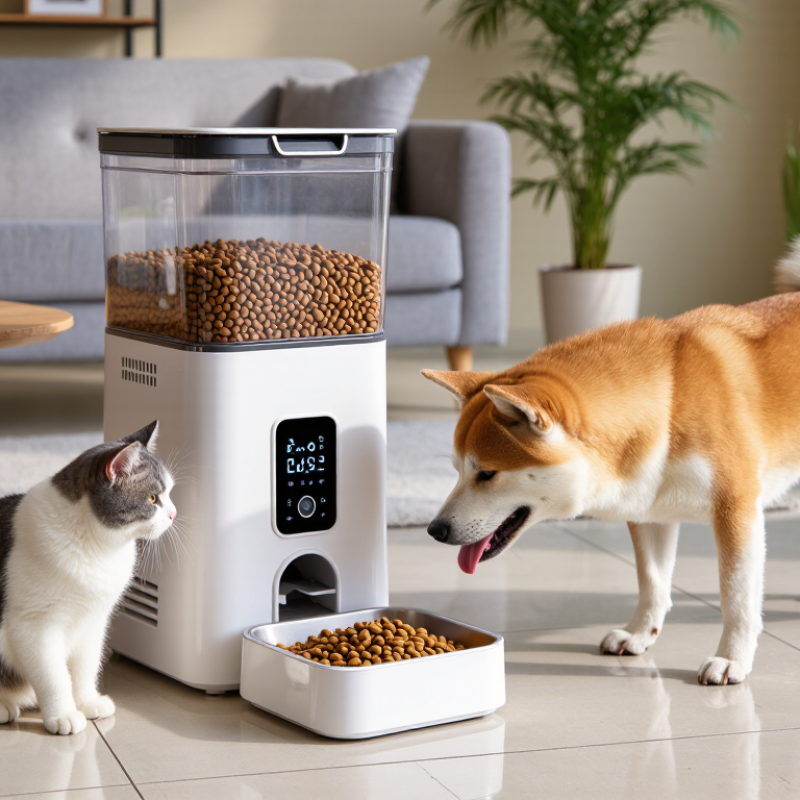
China Top Automatic Pet Feeders Are They Safe for Pets?

What Are Automatic Pet Feeders and How Do They Work?

China Top Automatic Pet Feeders: Are They Safe for Pets?

What Are Automatic Pet Feeders and How Do They Work?

An automatic pet feeder stores dry food in a covered container. A timer activates a small motor at scheduled times. The motor releases food through a rotating wheel or measured tray. Some models use sensors to detect blockages or low food levels. Others connect to a phone application for remote scheduling. The basic goal is simple: deliver controlled portions when owners are busy or away.

In daily use, safety depends on design and maintenance. A feeder should stand firmly on the floor, especially around large or energetic pets. Its food path must stay dry and clear. Wet food requires stronger hygiene controls and should not sit warm for long periods. Check the portion size with a kitchen scale. “One serving” can mean very different amounts. Batteries may fail. Motors can jam. I have found that testing several meals before leaving home reveals problems early, though one test is not enough.

Tips: Wash removable parts regularly and dry them completely. Use fresh batteries during travel. Keep the feeder away from water bowls and chewing pets. Watch your pet eat from it at first. Some animals fear the motor sound. A backup feeding plan is still wise. No device is perfect.

Safety Standards for Automatic Pet Feeders Made in China

China Top Automatic Pet Feeders: Are They Safe for Pets?

Safety Standards for Automatic Pet Feeders Made in China

Automatic feeders made in China are not automatically unsafe. Safety depends on design, testing, materials, and quality control. The American Pet Products Association reported 66% of U.S. households owned a pet in 2023–2024. That scale makes feeder reliability important, especially when animals depend on scheduled meals.

A responsible feeder should meet applicable IEC 60335 household appliance requirements. Its power adapter should include overload, short-circuit, and overheating protection. Testing should come from an ISO/IEC 17025-accredited laboratory. Food-contact parts should be clearly identified and tested for material safety. RoHS compliance can also help limit restricted substances in electrical components. However, a compliance logo alone proves little. Request the test report, certificate number, rated voltage, and importer information. Check whether the report matches the exact model.

Tips: Look for a sealed battery compartment and stable, non-slip feet. Test portion accuracy for several days. Watch for jammed food, weak alerts, or unusual heat. The 2023–2024 APPA survey counted about 86.9 million U.S. pet-owning households, but it does not verify feeder safety. That limitation matters. I would not trust a polished product page without traceable documents. Replace damaged cables quickly, and keep backup food available. Even good testing cannot prevent every mechanical failure.

China Top Automatic Pet Feeders Are They Safe for Pets? - Safety Standards for Automatic Pet Feeders Made in China

Safety Dimension Relevant Standard or Reference What Should Be Checked Typical Evidence Risk Level
Electrical shock and fire protection GB 4706.1 and IEC 60335-1 principles for household electrical appliances Insulation, grounding where applicable, abnormal-operation testing, accessible live parts, plug and power-adapter safety, and protection against overheating. Electrical safety test report, rated-voltage information, production inspection records, and a traceable power-adapter certificate. High
Electromagnetic compatibility GB 4343.1 and applicable EMC requirements for household appliances Conducted and radiated emissions, immunity to electrostatic discharge, electrical fast transients, and voltage disturbances. EMC laboratory report identifying the tested model, hardware version, operating modes, and test limits. Medium
Food-contact materials GB 4806 series for food-contact materials and products Material identity, overall migration, specific migration where relevant, pigment safety, odor, and suitability for dry or wet pet food. Material declaration and food-contact migration report for the bowl, hopper, chute, seal, and other food-contact parts. High
Cleaning and microbial control Hygienic design principles and manufacturer cleaning instructions Removable food-contact parts, smooth surfaces, limited dead spaces, drainage, resistance to the stated cleaning method, and prevention of trapped moisture. Disassembly instructions, cleaning-frequency guidance, durability testing, and user-maintenance documentation. Medium
Mechanical and pinch-point safety General product-safety and machinery-risk assessment principles Auger and rotating parts should be inaccessible during normal use; the mechanism should resist jamming and stop safely when obstructed. Jam tests using the specified food types, access-probe assessment, overload testing, and restart-behavior evaluation. High
Portion accuracy Performance verification based on the product's declared portion size Actual delivered quantity should be measured across repeated cycles, food shapes, fill levels, and battery or voltage conditions. A documented sampling plan with measured grams per serving, repeatability results, and clearly stated food-type limitations. Medium
Backup power and feeding continuity Product-specific reliability testing; battery requirements where rechargeable cells are used Operation during power interruption, low-battery warning, retained schedules, safe restart, and protection against repeated overfeeding. Power-loss test results, battery-runtime data, low-battery alert verification, and schedule-retention test records. Medium
Rechargeable battery safety IEC 62133-2 for portable sealed secondary lithium cells and batteries; UN 38.3 for transport testing Overcharge, short-circuit, abnormal charging, temperature exposure, mechanical abuse, cell identification, and transport compliance. Battery safety report, UN 38.3 test summary, charger specifications, protection-circuit information, and transport documentation. High
Moisture and water resistance IEC 60529 for IP-code testing, only when an IP rating is formally claimed Protection of electrical components from spills, condensation, and cleaning water; the claimed IP rating must match the tested configuration. IP test report, installation limitations, cleaning warnings, and confirmation that covers and seals were fitted during testing. Medium
Radio and wireless functions Applicable Chinese radio-frequency and EMC requirements; destination-market radio rules Radio frequency, transmit power, antenna configuration, coexistence, cybersecurity controls, and safe behavior when the network is unavailable. Wireless test report, module approval records where required, software-version traceability, and offline-operation test results. Medium
Animal-access and tip-over stability Product-specific stability and foreseeable-use assessment The feeder should remain stable when pushed, climbed on, or pulled; cables and detachable parts should not create accessible hazards. Tip-over tests, cable-retention evaluation, enclosure inspection, and testing with the intended animal-use environment. Medium
Labels and user instructions Applicable product-labeling, electrical-rating, and consumer-safety requirements Rated voltage, input power, warnings, cleaning instructions, food-size limits, battery information, traceability, and emergency-use guidance. Photographs of permanent markings, multilingual instructions, model and lot identification, and consistency between the label and test report. Medium
Assessment note: A standard reference alone does not prove that a particular automatic pet feeder complies. Verification should match the exact model, power supply, battery, materials, firmware version, and intended sales market.

Potential Health and Mechanical Risks for Pets

China Top Automatic Pet Feeders: Are They Safe for Pets?

Automatic feeders can support regular meal times, but they are not completely risk-free. Health problems may develop when a pet receives incorrect portions for several days. Overeating can cause weight gain, vomiting, or digestive discomfort. Missed meals may affect pets with diabetes or other medical conditions. Wet food can also spoil quickly in warm rooms. A clean bowl matters. Small food particles may collect beneath the dispensing tray and support bacterial growth.

Mechanical failures create different dangers. A blocked chute can stop food delivery without obvious warning. Weak batteries may cause the same problem. Curious cats might push paws into moving parts, while dogs could chew exposed cords. A loose lid may also allow overeating. In practical home checks, owners should test the feeder with the pet nearby. Watch for unusual sounds, uneven portions, or sudden changes in eating behavior. Not every failure is dramatic; quiet underfeeding can be harder to notice.

Tips: Measure several portions before regular use. Compare the dispensed amount with a kitchen scale. Clean food-contact parts frequently, and replace batteries early. Keep cords protected and place the unit on a stable surface. Use a camera or ask someone to check during long trips. Veterinary advice is important for pets needing timed medication or strict diets. I would not rely on one device completely. Technology helps, but careful observation still catches problems that the machine cannot.

China Top Automatic Pet Feeders: Are They Safe for Pets?

Automatic pet feeders can reduce missed meals, but they do not eliminate supervision risks. The chart shows a qualitative hazard-priority score based on the potential severity and likelihood of common failure modes. It is not a product defect rate, injury statistic, or brand comparison.

Pet owners should keep food dry and fresh, test dispensing accuracy, inspect moving parts, prevent access to batteries and power cables, and avoid relying on an automatic feeder for pets requiring medical or closely monitored feeding.

How to Evaluate a Feeder Before Buying or Using It

An automatic feeder is safe only when its design matches the pet, food, and home routine. APPA’s 2023–2024 National Pet Owners Survey reported that 66% of U.S. households owned a pet. That scale makes feeding reliability more than a convenience issue. Check the portion test first. Weigh ten dispensed meals on a kitchen scale, then compare the variation. A screen showing “10 grams” proves little. Kibble size, oil, and hopper shape can change the result. APOP’s 2022 survey estimated that 59% of dogs and 61% of cats were overweight or obese. Inaccurate portions can quietly worsen this problem.

Before buying a China-made or imported feeder, inspect food-contact surfaces, seals, and removable parts. They should be smooth, odorless, and easy to wash. Avoid narrow corners where greasy residue remains. Confirm whether the manufacturer states material specifications, electrical ratings, and cleaning limits. Country of manufacture is not a safety certificate. Test the lid, rotor, and jam alert with the exact food used at home. Unplug it briefly. Does it preserve the schedule? Battery backup matters during outages, but batteries can also fail. No feeder is foolproof. Keep a second feeding plan for travel, illness, or a stuck motor. I would choose an alert that records missed dispensing, not merely an app connection. That difference is easy to overlook. If a pet reacts badly to a new food, stop the trial and ask a veterinarian. A feeder controls delivery, not medical risk.

Safe Setup, Cleaning, and Ongoing Monitoring

China’s top automatic pet feeders can make meal routines more consistent, but safety depends on careful setup. Choose a stable unit with a wide base and protected moving parts. Keep it away from water, heat, and curious paws. Test each portion with a kitchen scale for several days. A programmed serving may differ from the stated estimate. This matters for pets with obesity, diabetes, or prescribed diets. Do not treat the feeder as a replacement for veterinary guidance. Check battery backup before travel. Power failures happen.

Tips: Unplug the feeder before cleaning. Wash removable food-contact parts with mild soap, unless the instructions say otherwise. Dry every piece completely. Moisture can encourage mold inside small corners. Inspect the chute for crumbs, oil, or stuck kibble. Use only food types approved for that feeder. Wet food needs special cooling support and should not sit unrefrigerated for long. It is easy to clean the bowl and forget the dispensing path.

Ongoing monitoring still matters. Watch your pet eat during the first week. Confirm the lid stays closed and the schedule works correctly. Check stool, appetite, weight, and unusual food-seeking behavior. A missed meal may signal a jam, empty hopper, or health problem. Older pets may need closer observation. Even reliable equipment can fail quietly. Keep a simple feeding log, though I admit many owners stop recording after a few days. That gap can hide small changes.

FAQS

Are automatic pet feeders made in China safe?

They can be safe. Country of manufacture does not prove quality or danger. Design, materials, testing, and quality control matter more.

Which safety documents should I request?

Ask for test reports, certificate numbers, rated voltage, and importer details. Check that every document matches the exact feeder model.

What electrical protections should the feeder have?

The power adapter should protect against overload, short circuits, and overheating. Testing from an ISO/IEC 17025-accredited laboratory adds useful confidence.

How can I test portion accuracy?

Weigh ten dispensed meals with a kitchen scale. Compare the amounts. A screen showing “10 grams” proves very little.

What health problems can incorrect portions cause?

Overfeeding may cause weight gain, vomiting, or digestive discomfort. Underfeeding can be serious for pets with diabetes or strict diets.

Can wet food remain safely inside an automatic feeder?

Wet food may spoil quickly in warm rooms. Clean the bowl often. Remove food particles beneath the dispensing tray.

What mechanical dangers should I watch for?

Blocked chutes, weak batteries, loose lids, and exposed cords can cause problems. Curious pets may reach moving parts. Quiet failures matter.

How should I place and maintain the feeder?

Use stable, non-slip feet and protect electrical cords. Clean removable food parts regularly. Replace damaged cables and weak batteries early.

Is an app connection enough to prove reliable feeding?

No. Choose alerts that record missed dispensing. Test the feeder with real food, sudden unplugging, and a short power interruption.

What backup plan should I keep?

Keep extra food available and arrange a person or camera check during long trips. I would not trust one device completely.

Conclusion

Automatic pet feeders made in China can offer convenient, scheduled meal delivery, but their safety depends on design, materials, manufacturing quality, and proper use. These devices typically use timers, portion controls, sensors, and rotating or dispensing mechanisms to release food at set times. When evaluating whether are automatic pet feeders safe for pets, owners should check for sturdy construction, pet-safe materials, reliable power systems, secure lids, accurate portioning, and clear operating instructions. Products with strong quality control and appropriate safety testing are generally more dependable.

However, feeders may create risks if they jam, dispense too much or too little food, lose power, or are difficult to clean. Moisture, leftover food, and hidden residue can support bacterial growth, while loose parts or accessible cables may cause injury. Owners should test the feeder before regular use, place it on a stable surface, clean it frequently, refill it correctly, and monitor their pet’s eating habits. Automatic feeding should support, not replace, regular supervision and veterinary guidance when health concerns arise.

Charlotte

Charlotte

Charlotte is a seasoned marketing professional with a deep understanding of the company's portfolio and a passion for elevating its presence in the market. With a keen eye for detail and a commitment to excellence, she ensures that our professional blog is regularly updated with insightful articles......